Wednesday, May 30, 2018
Tuesday, May 29, 2018
Monday, May 28, 2018
Sunday, May 27, 2018
Saturday, May 26, 2018
Friday, May 25, 2018
Thursday, May 24, 2018
Wednesday, May 23, 2018
Tuesday, May 22, 2018
Monday, May 21, 2018
Sunday, May 20, 2018
Saturday, May 19, 2018
Friday, May 18, 2018
Thursday, May 17, 2018
Wednesday, May 16, 2018
Tuesday, May 15, 2018
Friday, May 11, 2018
Thursday, May 10, 2018
Tuesday, May 8, 2018
Monday, May 7, 2018
What'sNewWith ..
Wednesday, April 18, 2018
Friday, March 23, 2018
Wednesday, February 21, 2018
Tuesday, January 23, 2018
Notarial Data
To review recent changes, hover and/or click to find your state.
reference from @ http://members.usnotaries.net/files/Recap-of-Notary-Laws-that-Went-into-Effect-in-2017.pdf
Texas _ _ _ _ _ _ _ _ _ _ _ _ _ _ _ _ _ _ _ _ _ _ _ _ _ _ _ _ _ _ _ _ _ _ _ _ _ _ _ _ _ _ _ _ _ _ _ _ _ _ _ _ _ _ _ _ _ _ _ _ _ _ _ _ _ _ _ _ _ _ _ _ _ SB 1098 — Effective Date: September 1, 2017. SB 1098 amends Section 406.014 (a) and (c) of the Texas Government Code and Section 121.012 (b) and (c) of the Texas Civil Practice and Remedies Code. This bill: n Allows the signer, grantor, maker, witness, and credible witness, as applicable, of an instrument the option to provide a mailing address in lieu of a residence address to a notary public for his or her mandatory journal requirements. n Removes the requirement of a notary public to record in his or her mandatory journal the known or alleged “residence address” of the signer, grantor, maker, witness, or credible witness, as applicable, when notarizing instruments; instead, a notary public is required to record the mailing address of the individual in his or her journal. n Amends the Government Code to substitute references to a residence or alleged residence, as applicable, in the required records of a notary public with references to a mailing address. n Removes the statutory obligation of a notary public to provide a certified copy of any record in the notary’s office to any person requesting the copy. n Requires a notary public, on payment of all fees, to provide a certified copy of any record of official acts in the notary public’s book of record to any person requesting the copy. n Requires an officer authorized by law (including a notary public) to take an acknowledgment or proof of a written instrument required or permitted by law to record a “mailing address” instead of a “residence.” n Amends the Civil Practice and Remedies Code to substitute references to a residence or alleged residence, as applicable, in a statement of an acknowledgment or proof of a written instrument with references to a mailing address. View Bill Text: http://www.capitol.state.tx.us/tlodocs/85R/billtext/html/SB01098F.htm SB 1193 — Effective Date: September 1, 2017. SB 1193 was signed and approved by the Governor on June 1, 2017. SB 1193 adds Title 4 to Chapter 2001 to the Texas Estates Code. SB 1193 enacts the Texas Revised Uniform Fiduciary Access to Digital Assets Act. SB 1193 grants a fiduciary the legal authority to manage digital assets and electronic communications should the principal die or become unable to manage his or her digital assets. This bill: n Grants fiduciaries the legal authority to manage digital assets and electronic communications in the same manner that they manage tangible assets and accounts by power of attorney. Legislative Report: Recap of notary laws in 2017, Continued from page 14 FOURTH QUARTER 2017 15 Continued on page 16 n Defines digital assets as electronic records in which a person has a personal interest or right, which include computer files, web domains, and virtual currency. n Stipulates that digital assets may include or restrict a fiduciary’s access to electronic communications such as emails, text messages, social media accounts, online photographs, electronic files stored in “the cloud,” and other electronic communications or records unless the principal consents in a will, trust, power of attorney, or other record. n Amends the statutory power of attorney form to grant this legal authority to an agent by a principal regarding his or her digital assets. n Requires the statutory power of attorney to be acknowledged before a notary public. SB 1400 — Effective Date: September 1, 2017. SB 1400 amends Sections 33.002, 59.109, 202.001, 204.105, and 204.203(a) and repeals Sections 204.203 (b), (c) and (d) of the Finance Code. SB 1400 improves the procedures for a safe deposit company to open a safe deposit box under certain circumstances in the presence of certain employees, at least one of whom is a notary public. View Bill Text: http://www.capitol.state.tx.us/tlodocs/85R/billtext/html/SB01400F.htm SB 2065 — Effective Date: September 1, 2017. SB 2065 amends Section 17.46 of the Texas Business and Commerce Code and Section 406.017 of the Texas Government Code. This bill: n Prohibits notaries public from translating into a foreign language the titles “immigration consultant” and “immigration expert” when advertising notarial services and stipulates that such an act constitutes a false, misleading, or deceptive act or practice. n Clarifies that a notary public who offers or provides language translation or typing services and accepts compensation for such services is not in violation of Section 406.017. View Bill Text: http://www.capitol.state.tx.us/tlodocs/85R/billtext/html/SB02065F.htm HB 1974 — Effective Date: September 1, 2017. HB 1974 was signed and approved by the Governor on June 15, 2017. HB 1974 modifies the law concerning durable powers of attorney by enacting provisions from the Uniform Power of Attorney Act. This bill requires a durable power of attorney to be acknowledged before a notary public. HB 1974 adds new sections to and amends existing sections of Chapter 751 and 752 of the Texas Estates Code. This bill: n Authorizes the adult principal to direct another adult to sign the principal’s name on a durable power of attorney. n Requires the principal to acknowledge his or her signature before a notary public or other notarial officer authorized to take acknowledgments or administer oaths. n Requires the adult directed by the principal to sign the principal’s name to make the acknowledgment to a notary public. n Grants a presumption of genuineness to a signature that purports to be the signature of the principal or of another adult directed by the principal on a durable power of attorney if the notarial officer taking the acknowledgment complied with the requirements of Section 121.004(b) of the Texas Civil Practices and Remedies Code. n Permits a durable power of attorney to be an electronic record and electronically signed and notarized. n Modifies the statutory form to include the new provisions. View Bill Text: http://www.capitol.state.tx.us/tlodocs/85R/billtext/html/HB01974F.htm HB 2157 — Effective Date: September 1, 2017. HB 2157 was signed and approved by the Governor on June 9, 2017. HB 2157 amends Sections 141.031(a) and 141.065 of the Texas Election Code. This bill amends the Texas Election Code to require a candidate’s application for a place on the ballot to be signed and sworn to before a notary public. This bill: n Requires a candidate’s application for a place on the ballot to be signed and sworn to before a notary public. n Requires that an affidavit of the person who circulated the petition be executed before a notary public for each part of the petition. n Provides that a single notarized affidavit by any person who obtained signatures is valid for all signatures gathered by the person if the date of notarization is on or after the date of the last signature obtained by the person.
reference from @ http://members.usnotaries.net/files/Recap-of-Notary-Laws-that-Went-into-Effect-in-2017.pdf
Texas _ _ _ _ _ _ _ _ _ _ _ _ _ _ _ _ _ _ _ _ _ _ _ _ _ _ _ _ _ _ _ _ _ _ _ _ _ _ _ _ _ _ _ _ _ _ _ _ _ _ _ _ _ _ _ _ _ _ _ _ _ _ _ _ _ _ _ _ _ _ _ _ _ SB 1098 — Effective Date: September 1, 2017. SB 1098 amends Section 406.014 (a) and (c) of the Texas Government Code and Section 121.012 (b) and (c) of the Texas Civil Practice and Remedies Code. This bill: n Allows the signer, grantor, maker, witness, and credible witness, as applicable, of an instrument the option to provide a mailing address in lieu of a residence address to a notary public for his or her mandatory journal requirements. n Removes the requirement of a notary public to record in his or her mandatory journal the known or alleged “residence address” of the signer, grantor, maker, witness, or credible witness, as applicable, when notarizing instruments; instead, a notary public is required to record the mailing address of the individual in his or her journal. n Amends the Government Code to substitute references to a residence or alleged residence, as applicable, in the required records of a notary public with references to a mailing address. n Removes the statutory obligation of a notary public to provide a certified copy of any record in the notary’s office to any person requesting the copy. n Requires a notary public, on payment of all fees, to provide a certified copy of any record of official acts in the notary public’s book of record to any person requesting the copy. n Requires an officer authorized by law (including a notary public) to take an acknowledgment or proof of a written instrument required or permitted by law to record a “mailing address” instead of a “residence.” n Amends the Civil Practice and Remedies Code to substitute references to a residence or alleged residence, as applicable, in a statement of an acknowledgment or proof of a written instrument with references to a mailing address. View Bill Text: http://www.capitol.state.tx.us/tlodocs/85R/billtext/html/SB01098F.htm SB 1193 — Effective Date: September 1, 2017. SB 1193 was signed and approved by the Governor on June 1, 2017. SB 1193 adds Title 4 to Chapter 2001 to the Texas Estates Code. SB 1193 enacts the Texas Revised Uniform Fiduciary Access to Digital Assets Act. SB 1193 grants a fiduciary the legal authority to manage digital assets and electronic communications should the principal die or become unable to manage his or her digital assets. This bill: n Grants fiduciaries the legal authority to manage digital assets and electronic communications in the same manner that they manage tangible assets and accounts by power of attorney. Legislative Report: Recap of notary laws in 2017, Continued from page 14 FOURTH QUARTER 2017 15 Continued on page 16 n Defines digital assets as electronic records in which a person has a personal interest or right, which include computer files, web domains, and virtual currency. n Stipulates that digital assets may include or restrict a fiduciary’s access to electronic communications such as emails, text messages, social media accounts, online photographs, electronic files stored in “the cloud,” and other electronic communications or records unless the principal consents in a will, trust, power of attorney, or other record. n Amends the statutory power of attorney form to grant this legal authority to an agent by a principal regarding his or her digital assets. n Requires the statutory power of attorney to be acknowledged before a notary public. SB 1400 — Effective Date: September 1, 2017. SB 1400 amends Sections 33.002, 59.109, 202.001, 204.105, and 204.203(a) and repeals Sections 204.203 (b), (c) and (d) of the Finance Code. SB 1400 improves the procedures for a safe deposit company to open a safe deposit box under certain circumstances in the presence of certain employees, at least one of whom is a notary public. View Bill Text: http://www.capitol.state.tx.us/tlodocs/85R/billtext/html/SB01400F.htm SB 2065 — Effective Date: September 1, 2017. SB 2065 amends Section 17.46 of the Texas Business and Commerce Code and Section 406.017 of the Texas Government Code. This bill: n Prohibits notaries public from translating into a foreign language the titles “immigration consultant” and “immigration expert” when advertising notarial services and stipulates that such an act constitutes a false, misleading, or deceptive act or practice. n Clarifies that a notary public who offers or provides language translation or typing services and accepts compensation for such services is not in violation of Section 406.017. View Bill Text: http://www.capitol.state.tx.us/tlodocs/85R/billtext/html/SB02065F.htm HB 1974 — Effective Date: September 1, 2017. HB 1974 was signed and approved by the Governor on June 15, 2017. HB 1974 modifies the law concerning durable powers of attorney by enacting provisions from the Uniform Power of Attorney Act. This bill requires a durable power of attorney to be acknowledged before a notary public. HB 1974 adds new sections to and amends existing sections of Chapter 751 and 752 of the Texas Estates Code. This bill: n Authorizes the adult principal to direct another adult to sign the principal’s name on a durable power of attorney. n Requires the principal to acknowledge his or her signature before a notary public or other notarial officer authorized to take acknowledgments or administer oaths. n Requires the adult directed by the principal to sign the principal’s name to make the acknowledgment to a notary public. n Grants a presumption of genuineness to a signature that purports to be the signature of the principal or of another adult directed by the principal on a durable power of attorney if the notarial officer taking the acknowledgment complied with the requirements of Section 121.004(b) of the Texas Civil Practices and Remedies Code. n Permits a durable power of attorney to be an electronic record and electronically signed and notarized. n Modifies the statutory form to include the new provisions. View Bill Text: http://www.capitol.state.tx.us/tlodocs/85R/billtext/html/HB01974F.htm HB 2157 — Effective Date: September 1, 2017. HB 2157 was signed and approved by the Governor on June 9, 2017. HB 2157 amends Sections 141.031(a) and 141.065 of the Texas Election Code. This bill amends the Texas Election Code to require a candidate’s application for a place on the ballot to be signed and sworn to before a notary public. This bill: n Requires a candidate’s application for a place on the ballot to be signed and sworn to before a notary public. n Requires that an affidavit of the person who circulated the petition be executed before a notary public for each part of the petition. n Provides that a single notarized affidavit by any person who obtained signatures is valid for all signatures gathered by the person if the date of notarization is on or after the date of the last signature obtained by the person.Saturday, December 30, 2017
e-signatures
C'mon Now.
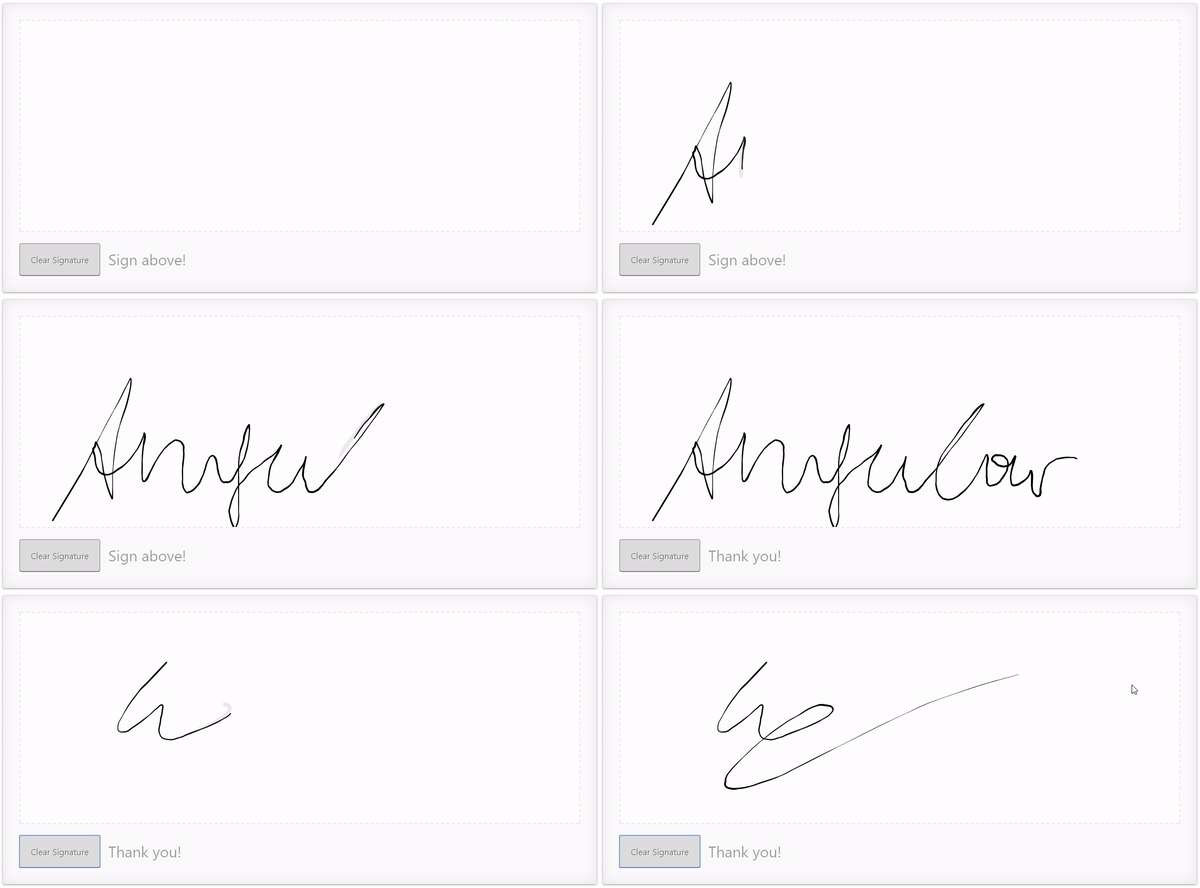
Using that screen or signature pad to sign that document is not as easy as one would think.
It takes a bit of training to sign your signature or else it could and would look like someone signed that didn't practice handwriting. lol @ different signatures on screen.
I've downloaded several mobile apps in efforts of practicing my own digital signature. It is not an easy task. You will have to find the one that best suits your writing style with your said pen. I've looked and There are some differences among them all.

Using that screen or signature pad to sign that document is not as easy as one would think.
It takes a bit of training to sign your signature or else it could and would look like someone signed that didn't practice handwriting. lol @ different signatures on screen.
I've downloaded several mobile apps in efforts of practicing my own digital signature. It is not an easy task. You will have to find the one that best suits your writing style with your said pen. I've looked and There are some differences among them all.
Have you tested any signature creating apps, today, from your mobile?
signing off
Thanks for reading!
Tuesday, November 7, 2017
Saturday, November 4, 2017
Subscribe to:
Comments (Atom)
Followers
Contact Form
Notarial & Non-Notarial Services
Landings
Blog Archive
- February (1)
- January (1)
- April (1)
- October (1)
- December (1)
- November (2)
- March (2)
- January (6)
- December (3)
- June (1)
- March (1)
- February (1)
- November (1)
- October (9)
- September (12)
- August (3)
- July (1)
- June (5)
- May (22)
- April (2)
- March (1)
- February (1)
- January (1)
- December (1)
- November (3)
- October (6)
- September (3)
- August (4)
- July (9)
- June (1)
- May (4)
- April (13)
- March (8)
- February (32)
- January (2)
- November (6)
- October (2)
- September (20)
- August (2)
- June (3)